
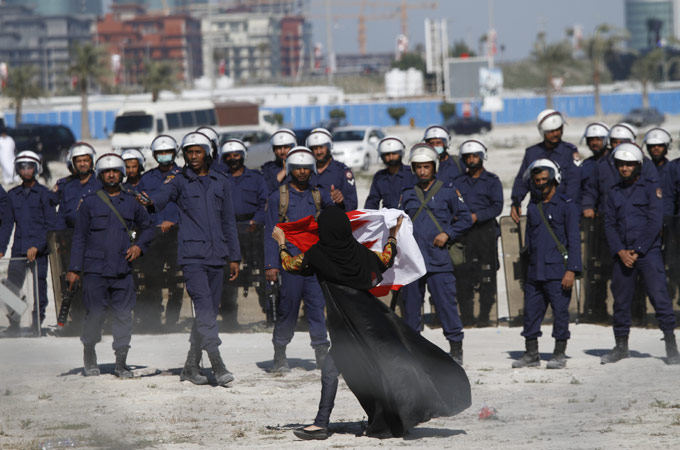
via IPS News
The special session of the Bahraini National Assembly held on Sunday Jul. 28 was a spectacle of venom, a display of vulgarity, and an unabashed nod to increased dictatorship.
Calling the Shia “dogs”, as one parliamentarian said during the session, which King Hamad convened, the Al-Khalifa have thrown away any hope for national reconciliation and dialogue.
The 22 recommendations approved during the session aimed at giving the regime pseudo-legal tools to quash dissent and violate human and civil rights with impunity. All in the name of fighting “terrorism”.
Watching a video of some of the speeches during the session, one is saddened by how low official political discourse has become. Students of Bahrain yearn for the days when parliamentary debaters were civil and when Shia and Sunni parliamentarians engaged in thoughtful, rational, and tolerant debates despite their political or ideological differences.
In the early 1970s when the Constituent Assembly debated the draft constitution, Bahrainis followed the speeches by their elected and appointed representatives with much respect and hope for the future of a modern, tolerant, and civil society.
Such parliamentarians as Rasul al-Jishi, Jasim Murad, Ali Saleh, Abd al-Aziz Shamlan, Ali Sayyar, Isa Qasim, Qasim Fakhro, and others made their countrymen proud with the quality of debate that characterised Bahrain’s first ever elected parliament.
Even such ministers as Muhammad bin Mubarak al-Khalifa, Ali Fakhro, and Yusif Shirawi participated in those parliamentary debates and worked jointly with elected members to chart a more hopeful future for all the people of Bahrain.
As I sat through those parliamentary sessions in 1973 and followed the lengthy discussions on a myriad of constitutional amendments, I envisioned a democratically prosperous Bahrain for years to come. The National Assembly, however, was dissolved two years later, and the constitution was suspended. Al-Khalifa ruled by decree ever since.
The parliamentary special session last Sunday showed a divisive, intolerant, and fractured country that is rapidly descending into chaos. It’s as if civility, rationality, and moderation have become relics from the past.
King Hamad and the Crown Prince welcomed the recommendations, and the powerful prime minister urged his ministers to implement them immediately; in fact, he has threatened to fire any minister who slows their implementation.
According to media reports, the recommendations were prepared before the meeting and were disseminated to the media a few minutes after the session ended. They were not even debated meaningfully or rationally during the session.
The regime’s fear that Bahrainis would have their own “tamarud” (rebellion) civil disobedience movement to confront the regime on Aug. 14, Bahrain’s actual independence day, drove the timing of the session. The Bahraini opposition hopes to emulate the Egyptian “tamarud”, which indirectly led to Morsi’s removal.
Like other autocratic regimes, whether under Abdel Fattah al-Sisi in Egypt or Bashar al-Assad in Syria, Al-Khalifa justified the draconian recommendations against all forms of opposition and peaceful dissent in the name of fighting “terrorism” and incitement of “all forms of violence” (Recommendation #3). The regime will likely use these recommendations to ban all peaceful demonstrations and protests.
The regime is prepared, according to Recommendation #2, to revoke the citizenship of Bahraini citizens “who carry out terrorist crimes and those who instigate terrorism”. The regime defines a terrorist as any Bahraini who is suspected of being a dissident or actively advocating genuine reforms. In fact, Recommendation #6 bans “sit-ins, rallies and gatherings in the capital Manama”.
The regime does not seem perturbed by the fact that citizenship revocation violates international legal norms and the Bahraini constitution. In fact, this might be a sinister way for the Sunni al-Khalifa to alter the demographics of the country by depriving the Shia dissidents of citizenship.
Viewing the entire protest movement through the security prism, as the recommendations imply, the regime seems bent on escalating its crackdown against peaceful protest and freedoms of speech and assembly, according to the Bahrain Centre for Human Rights.
Under Recommendation #7, the country could soon be ruled under martial law or “National Safety”, as the regime euphemistically calls it.
The recommendations have put the country on a sectarian collision course, have dealt a major blow to peaceful dissent and civil rights, and have raised serious questions in Washington about Al-Khalifa’s commitment to genuine reform.
In a direct rebuke to U.S. Ambassador Thomas Krajeski, Recommendation #11 requests “that all ambassadors to Bahrain to not interfere in the kingdom’s domestic affairs.”
Some die-hard Sunni parliamentarians, with the support of the Royal Court, have urged the regime to expel Ambassador Krajeski from Bahrain, claiming he has been meeting with pro-democracy Shia dissidents. Others have threatened his personal safety.
Still others, with tacit regime support, are hoping the ambassador would be transferred out of Bahrain, much like what happened to political officer Ludovic Hood in May 2011.
At the time, according to the “Religion and Politics in Bahrain” blog, pro-regime Sunni activists demanded Hood’s removal because they claimed he offered “Krispy Kreme doughnuts to demonstrators who had gathered outside the American Embassy” to protest perceived U.S. support for Al-Khalifa.
Now pro-regime Sunni activists are feverishly campaigning against the U.S. ambassador’s public support for human rights and genuine reform in Bahrain. The recommendation curtailing diplomatic activities in the country is squarely aimed at Ambassador Krajeski.
According to Bahrain Mirror, some have advocated banning him from appearing on state media and in pro-regime newspapers, even if the subject he is discussing is gourmet cooking, one of the ambassador’s hobbies!
The anti-Shia and anti-reform underlying theme of the recommendations is a naked display of tribal family autocracy, which Al-Khalifa are determined to preserve at any cost, including tearing the society apart. Adopting these recommendations reflects the regime’s nervousness about the ever-increasing precarious nature of their rule and the unstoppable demands for justice, dignity, and equality.
According to a recently leaked audio recording, Crown Prince Salman was quoted as saying, “The current situation is unsustainable, and the policy we are pursuing cannot continue. People are getting tired, and conditions could worsen any moment. Bigger dangers are threatening our society, and the future is becoming more precarious.”
Washington and other Western capitals should work diligently to disabuse the king and the prime minister of the notion that “securitisation” is the answer to Bahrain’s domestic ills. Engaging with the public on the future of Bahrain, including the Shia majority and the pro-democracy youth movement, is the only way to bring the country back from the brink.
Washington should make it clear to Al-Khalifa that media attacks and threats against Ambassador Krajeski should stop. Whipping the flames of hatred against the U.S. embassy to preserve the regime’s dictatorial rule is a dangerous game, which Al-Khalifa cannot afford to engage in.
As a first and immediate step, King Hamad should muzzle the hotheads in his Royal Court and in the prime minister’s office. In the meantime, the U.S. should initiate serious discussions on how and when to move the Fifth Fleet out of Bahrain to a neighbouring country or over the horizon.


Gentleman: Mr Abdul & Mr Bader, my hat’s off to the both of you, for what it’s worth, I believe I have witnessed an historical moment from this dialog. It might not reach the printed book[s], but it will forever be told that a bridge has been crossed, between the old and the new thinking in the M.E. Thank you for the enlightenment/education the both of you have presented, also the references that have been listed. It gives MOI a further enlightenment/education to pursue. Curious Mr. Abdul, as I reread your posts here, I get the impression you perhaps are an educator/teacher/professor, active/retired? Mr. Bader, your last post here indeed cements my belief that you and your peers are the future of the M.E. I hope that it catches fire and spreads, like the so-called Arab Spring. Good luck to the both of you, I have enjoyed this opportunity to participate.
I am not sure how to say this Bader but I am beginning to feel may be you are worthy of an investment which is the reason why I am slightly expanding my answers for the purpose of objectivity.
There is one point though that I mentioned in one of my comments which I would like to repeat so that we are clear on the way going forward. I have always believed in a multiethnic and multicultural Bahrain. I very much believe in secularism and the desire for a civil state with statutory laws in preference to a religious state.I am not with the government nor from the government. I’ve lived a lifetime with Shias. I have eaten their food; studied together since childhood; been friends ever since; are my business partners; etc. My children friends are Shias and they are in and out of my house till this very minute. I have nothing for the Shias of Bahrain other than an utmost admiration for their contribution towards the country and its development. Absolutely no question here. Since the 1979 Welayat Faqih however, they changed.
Many of my friends are from the Shia dominated opposition of Alwefaq. We engage in discussions the whole time. On one occasion, one of them expressed his resentment of Alwefaq “explicit” instructions to vote for either Jawad or Jalal Fairuz (not sure which) in one of Hamad Town’s electoral areas. He told me he didn’t think Jalal was worthy of his vote and that he wanted to vote for the other candidate but he had to obey Alwefaq instructions and vote for Jalal. This coupled with the Deraz elections of how Alwefaq less qualified Almetghawi won over a more qualified secular Shia candidate, I believe doesn’t further Alwefaq cause, and even yours Bader, that the opposition is secular.
I must admit Bader the turning point for Islam (for both Sunnis and Shias) to have become politically charged was the 1979 Iranian Revolution which brought Khomeini to power who created the teachings and doctrine of Welayat Faqih. The moment Khomeini came to power, this rhetoric of “exporting the revolution” started to surface. The 10 year old Iran Iraq war Bader with hundred thousands of deaths, in my opinion, was Iran to blame in every sense, when the Iraqi cleric Mohammed Baqer Al-sadr started to act as a proxy for Khomeini Welayat Faqih doctrine in Iraq, in an almost identical manner to that happening in Bahrain now. The Bahraini cleric Isa Qassim is Khamenaei’s Welayat Faqih in Bahrain with his mouthpiece Ali Salman. Bahrain is a precise replication of Iraq.
May be you want to embark on a study of Shia teachings. Have you ever heard the religious term “Alnawasib”, or “Ahl Alnasb”, or “Alnasiba”? followed by “Nasibiyat Ahl Alsunah”? “Alnawasib” or “Alnasiba” is a term known in ancient Shia books referring to Sunni animosity or hostility towards the fourth khalifa Ali Bin Abi Talib by advancing Abu Baker, Omar, and Othman on Ali. Remember there is a difference between “Alnawasib” and “alkhawarij”. “Alkhawarij” are known to have blasphemised Ali, thus are rejected by all Sunnis and Shias. “Alnawasib” Bader are those who Shias say debauched Ali (and not blasphemised). To go a bit deeper, there is this question of whether it was all Sunnis who debauched Ali or few. Some of the Shia teachings suggest “Alnasib” was the nakename of Imam Abu Hanifa and that “Alnasibi” was Imam Abu Hanifa. Most of Shia teachings however write that “ALL” Sunnis are “Nawasib”, and that Shias should never be ruled by Sunnis.
May be Bader you want to extract this information from (i) Book of Almufeed, Eddat Rasae’l fi Almasae’l Alsaaghaaniya, pages 253, 263, 265, 268 and 270 Qum Print, (ii) Book of Alqaafi, 8/292 by Islamic Publishing House, Tehran, Iran, (iii) Al Anwar Al No’maniya 2/307 Tabriz Print, Iran, (iv) Hidayat Al Abraar Ella Tareeq Al Ae’ma Al At’haar 106 1st Print 1396 Hijri Lunar year, plus many more.
I don’t want to upset Norman otherwise I’d be happy to send you copies of the pages by mail or even lend you the books. The books are all in Arabic and not sure you can find them in Wikipedia. Just in case you found some be careful as in matters of religion and politics I don’t have much faith in Wikipedia.
You see Bader, the Welayat Faqih is just the tip of the iceberg. It is certainly the end product of more profound teachings fueled by more extreme views and interpretations, as described above. These are the principal reasons why the conflict is very much religious.
By no means Bader I am saying there are no shortfalls or mismanagement on the part of the government. Of course there are and many of them. I would have loved to have an apposition that was national and not religious. It’s just that the use of secular rhetoric of human right, freedom, democracy, justice, fair distribution of wealth, dialogue, reconciliation, etc, by the religious Alwefaq can be quite frustrating.
Mr. Abdul, forgive me for using your 1st name in these many back & forth here, but I have found through time, that doing so, has a tendency to relieve the stuffiness of being formal. I don’t mean this in a way to be less respectful, but in this particular case, we three admittedly are years apart in age, and considering the dialog, civil as it has been. That said, I have to admit, I would embrace you generous offer, but have to decline, not out of any disrespect, but because it could bring us both undue attention to the great busy bodies that feel a need to snoop upon every thing that others do. I suppose that has already taken place, but then as you said, the books/pages/passages are in Arabic, which unfortunately I don’t have a comprehension of. This has been enlightening as I’ve previously said, so in a small way, understanding has been achieved both in Bahrain as well as in my country. I do hope that this will grow, for as I said earlier, nothing else seems to be working other than creating chaos. Government & Religion need to be kept separate, to avoid the problems that are now taking place. This may be the last time humankind can come to the table and achieve PEACE, without going through a Nuclear Winter. Peace to you and Bader.
Not sure if it’s fortunate or not but every time any one of us starts writing something crops up which needs to be attended to.
I guess the nature of the ups and downs in any dialogue is quite normal and healthy, if I might say. Bader, yourself Norman and I, are debating some sensitive issues amid the cross cultural barrier where one thinks apples and the other thinks they are oranges. At the end of the day, Bader (probably) but I (certainly) represent a High Context Culture where time is probably not that of a priority as much as establishing trust and confidence first, as opposed to probably you Norman who is coming from a Low Context Culture where time is of essence and want to move fast. I don’t wish to indulge in more details as I think it is a side issue now that we are rhyming in our thoughts and the way going forward.
Now this issue of state and religion; religion and state in our part of the world, and certainly in Bahrain, go hand in hand. They are part and parcel of each other. They are bundled with each other to the bone, unlike the West where religion and state are separate, thus the ideology of secularism and civil societies and statutory laws.
The bundled nature of state and religion In the Shia Welayat Faqih doctrine is even more profound than that in the Sunni doctrine. Take for example our Friday prayers where the masses congregate, the objective of which, is for the Imam (cleric) to preach RELIGOUS sermons followed by a 2 Rak’ah (kneels) prayers and off you go. Historically this has always been the case.
Things however changed following Khomeini’s Welayat Faqih doctrine with the 1979 Iranian Revolution. Friday prayers became a venue for the clerics to start preaching POLITICAL sermons as opposed to RELIGOUS. Iranian clerics such as the then Supreme Spiritual Leader Khomeini and now Khamenaei as well as the junior ones started stirring the masses by delving into politics talking of how “Hussain” son of “Ali” grandson of Prophet “Mohammed” Peace Be Upon Him “PBUH” was oppressed and killed by “Yazid Bin Ma’wiya”, and that (here where the teachings of Welayat Faqih starts kicking in) the followers of “Hussain” being Shias should start revolting against tyranny and oppression, being of course Sunnis, bearing in mind of the 1.6 billion muslims, only 14% are Shias and 86% are Sunnis. Sunnis are the “Umma” or “the Nation” and Shias are a “Tae’fa” or “Sect”. Quite an epic Norman! Isn’t it? Thus the genesis of Political Islam or Politicising Islam in Shia version of Islam and Sunni.
In every country where Shias are present you’d find a representative of Iranian Welayat Faqih. In Bahrain it’s Isa Qassim. So every Friday Isa Qassim attracts Shias to Friday prayers in the name of Islam and religion and gives political sermons of how, among other things, they should revolt against the government in the name of democracy, freedom, and justice. For your information Norman, Islam doesn’t recognise a secular democracy where people legislate. Islam recognises the “Quran” as the principal source of legislation.
Then there is the question “Marjaeiya” or “Reference” and “Moghalid” or “Imitator”. In the Shai doctrine, a Shia must follow a “Marja'” or have a “Moghalid”. Who are the “Marjaeyyat”? They Iranian Welayat Faqih Khamenaei, Sistani (who is Iranian) but is in Iraq, Khouei (who is Iranian) and is in Iran, Mohammed Hussain Fadhlulla in Lebanon. What all this is translating to is basically a Shia Bahraini or Shia Kuwaits or a Shia from Qatif in Saudi Arabia is following and executing the instructions of his “Marja'”, being one of the four “Marjaeyyat”, almost blindly.
Actually the Shias of Bahrain are quite vocal about the “Marjaeyyat” and they use the “Marjaeyyat” to stir havoc in the civil society every time they want to execute a political agenda. In the midst of all this they want us and the international community to believe that they and their movement is secular.
Unfortunately the West is not well versed with these intricate religious teachings and history, and being secular, the secular rhetoric of democracy, freedom, and justice that is being trumpeted by our Shia religious societies of Alwefaq is music to their ears not knowing they are capturing only half of the story and not the full story.
Apologies Norman for not knowing whether to write long or short. If I write short then it’s not the full picture and if long then it might not be read.
Hat’s off to the unsung heroes LobeLog and Emile Nakhleh. LobeLog didn’t censor a single word and published everything verbatim. A job well done.