
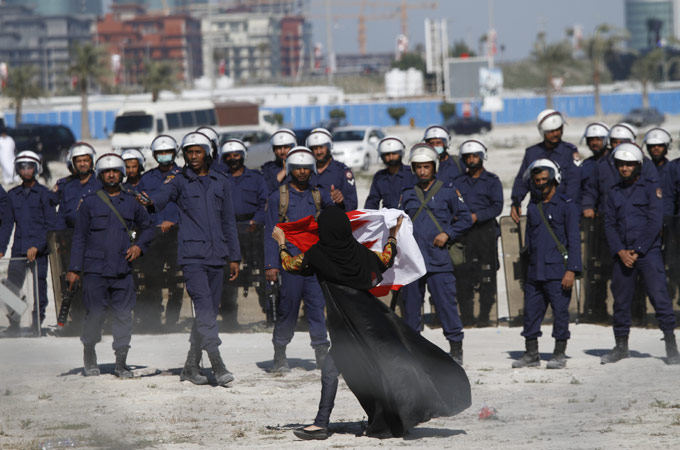
via IPS News
The special session of the Bahraini National Assembly held on Sunday Jul. 28 was a spectacle of venom, a display of vulgarity, and an unabashed nod to increased dictatorship.
Calling the Shia “dogs”, as one parliamentarian said during the session, which King Hamad convened, the Al-Khalifa have thrown away any hope for national reconciliation and dialogue.
The 22 recommendations approved during the session aimed at giving the regime pseudo-legal tools to quash dissent and violate human and civil rights with impunity. All in the name of fighting “terrorism”.
Watching a video of some of the speeches during the session, one is saddened by how low official political discourse has become. Students of Bahrain yearn for the days when parliamentary debaters were civil and when Shia and Sunni parliamentarians engaged in thoughtful, rational, and tolerant debates despite their political or ideological differences.
In the early 1970s when the Constituent Assembly debated the draft constitution, Bahrainis followed the speeches by their elected and appointed representatives with much respect and hope for the future of a modern, tolerant, and civil society.
Such parliamentarians as Rasul al-Jishi, Jasim Murad, Ali Saleh, Abd al-Aziz Shamlan, Ali Sayyar, Isa Qasim, Qasim Fakhro, and others made their countrymen proud with the quality of debate that characterised Bahrain’s first ever elected parliament.
Even such ministers as Muhammad bin Mubarak al-Khalifa, Ali Fakhro, and Yusif Shirawi participated in those parliamentary debates and worked jointly with elected members to chart a more hopeful future for all the people of Bahrain.
As I sat through those parliamentary sessions in 1973 and followed the lengthy discussions on a myriad of constitutional amendments, I envisioned a democratically prosperous Bahrain for years to come. The National Assembly, however, was dissolved two years later, and the constitution was suspended. Al-Khalifa ruled by decree ever since.
The parliamentary special session last Sunday showed a divisive, intolerant, and fractured country that is rapidly descending into chaos. It’s as if civility, rationality, and moderation have become relics from the past.
King Hamad and the Crown Prince welcomed the recommendations, and the powerful prime minister urged his ministers to implement them immediately; in fact, he has threatened to fire any minister who slows their implementation.
According to media reports, the recommendations were prepared before the meeting and were disseminated to the media a few minutes after the session ended. They were not even debated meaningfully or rationally during the session.
The regime’s fear that Bahrainis would have their own “tamarud” (rebellion) civil disobedience movement to confront the regime on Aug. 14, Bahrain’s actual independence day, drove the timing of the session. The Bahraini opposition hopes to emulate the Egyptian “tamarud”, which indirectly led to Morsi’s removal.
Like other autocratic regimes, whether under Abdel Fattah al-Sisi in Egypt or Bashar al-Assad in Syria, Al-Khalifa justified the draconian recommendations against all forms of opposition and peaceful dissent in the name of fighting “terrorism” and incitement of “all forms of violence” (Recommendation #3). The regime will likely use these recommendations to ban all peaceful demonstrations and protests.
The regime is prepared, according to Recommendation #2, to revoke the citizenship of Bahraini citizens “who carry out terrorist crimes and those who instigate terrorism”. The regime defines a terrorist as any Bahraini who is suspected of being a dissident or actively advocating genuine reforms. In fact, Recommendation #6 bans “sit-ins, rallies and gatherings in the capital Manama”.
The regime does not seem perturbed by the fact that citizenship revocation violates international legal norms and the Bahraini constitution. In fact, this might be a sinister way for the Sunni al-Khalifa to alter the demographics of the country by depriving the Shia dissidents of citizenship.
Viewing the entire protest movement through the security prism, as the recommendations imply, the regime seems bent on escalating its crackdown against peaceful protest and freedoms of speech and assembly, according to the Bahrain Centre for Human Rights.
Under Recommendation #7, the country could soon be ruled under martial law or “National Safety”, as the regime euphemistically calls it.
The recommendations have put the country on a sectarian collision course, have dealt a major blow to peaceful dissent and civil rights, and have raised serious questions in Washington about Al-Khalifa’s commitment to genuine reform.
In a direct rebuke to U.S. Ambassador Thomas Krajeski, Recommendation #11 requests “that all ambassadors to Bahrain to not interfere in the kingdom’s domestic affairs.”
Some die-hard Sunni parliamentarians, with the support of the Royal Court, have urged the regime to expel Ambassador Krajeski from Bahrain, claiming he has been meeting with pro-democracy Shia dissidents. Others have threatened his personal safety.
Still others, with tacit regime support, are hoping the ambassador would be transferred out of Bahrain, much like what happened to political officer Ludovic Hood in May 2011.
At the time, according to the “Religion and Politics in Bahrain” blog, pro-regime Sunni activists demanded Hood’s removal because they claimed he offered “Krispy Kreme doughnuts to demonstrators who had gathered outside the American Embassy” to protest perceived U.S. support for Al-Khalifa.
Now pro-regime Sunni activists are feverishly campaigning against the U.S. ambassador’s public support for human rights and genuine reform in Bahrain. The recommendation curtailing diplomatic activities in the country is squarely aimed at Ambassador Krajeski.
According to Bahrain Mirror, some have advocated banning him from appearing on state media and in pro-regime newspapers, even if the subject he is discussing is gourmet cooking, one of the ambassador’s hobbies!
The anti-Shia and anti-reform underlying theme of the recommendations is a naked display of tribal family autocracy, which Al-Khalifa are determined to preserve at any cost, including tearing the society apart. Adopting these recommendations reflects the regime’s nervousness about the ever-increasing precarious nature of their rule and the unstoppable demands for justice, dignity, and equality.
According to a recently leaked audio recording, Crown Prince Salman was quoted as saying, “The current situation is unsustainable, and the policy we are pursuing cannot continue. People are getting tired, and conditions could worsen any moment. Bigger dangers are threatening our society, and the future is becoming more precarious.”
Washington and other Western capitals should work diligently to disabuse the king and the prime minister of the notion that “securitisation” is the answer to Bahrain’s domestic ills. Engaging with the public on the future of Bahrain, including the Shia majority and the pro-democracy youth movement, is the only way to bring the country back from the brink.
Washington should make it clear to Al-Khalifa that media attacks and threats against Ambassador Krajeski should stop. Whipping the flames of hatred against the U.S. embassy to preserve the regime’s dictatorial rule is a dangerous game, which Al-Khalifa cannot afford to engage in.
As a first and immediate step, King Hamad should muzzle the hotheads in his Royal Court and in the prime minister’s office. In the meantime, the U.S. should initiate serious discussions on how and when to move the Fifth Fleet out of Bahrain to a neighbouring country or over the horizon.





Mr. Abdul, “THERE YOU GO AGAIN”, a famous quote over here by a past P.O.T.U.S. That said, why do you feel that you have to put others down-lower-than your self? I don’t talk down to you, but I do point out when the negativity emerges. I also admitted I don’t know your ways there in Bahrain, but that doesn’t mean I’m a low class citizen of my country. That’s what is wrong with the World today, especially yours. Here’s a pearl for you: “line everyone in the world up in a straight line in the nude, and the only difference is, size, shape, color.” There are strong ones, there are weak ones, some are leaders, some are followers, some are smart, some are not so, but in the end, we’re all of the human race. Because you are a successful businessman in your country, can cite the different book[s], passages, etc., doesn’t mean a thing in the big picture. I only interjected myself in this back & forth because I wanted too, wanted a different slant on a particular region of the world-the M.E.-because what takes place over there, has a bearing on the present as well as the future here as well as there, because of the U.S. Military presence as well as the total conflict in the M.E. I have enjoyed this back & firth, but you keep coming back with “I’m better than you”, as some school professors do when teaching/lecturing new students. Perhaps you’re a cleric also, I don’t know, or perhaps you sponsor/finance such. That’s not important here, for this is dialog, and as you may have noted, I misspell words, some on purpose, but the message does get across. Again, I will say that this has been informative, educational, but also disappointing at the same time. A civil dialog requires civility, not superiority. Constructive criticism sometimes is a better pill to swallow, especially for those unaccustomed to it. In a nut shell, that’s exactly what is wrong with the present thinking between all the factions in the M.E. vs the rest of the World, the so called elites thinking they are the chosen ones, while everyone else is beneath. Humility, Mr. Abdul, is something that needs to be taken seriously, not to be discarded if a true compromise is to be achieved. Again, I will say that Mr. Bader is correct in his dialog, his being the new way of thinking for a just peace. The way you speak, is still the old way, that which is responsible for the present situation you face in your country. Refusing to compromise, is the problem, education and changing what is the root cause of the problem, is what works best for all. As for the state/religious aspect, that also seems to be a sticking point. You mentioned the clerics in Iran, yet you have them also in your country, in fact, the whole of the Muslim World. I wonder, is it true that the Koran doesn’t mention or cite anything about murdering those who don’t go along with the cleric? Does it say that everyone who isn’t a Muslim, should be beheaded? Does it say that a suicide bomber who blows him/herself up, killing innocent people, should go to heaven as a martyr and have 70 slaves? Or is this something some cleric came up with to entice the lost, uneducated, into blowing themselves up for the cause? Why doesn’t the cleric do it himself? I ask these questions because you keep citing your intellect, while denigrating both Mr. Bader & MOI. I realize that this is going far afield of the original, but then, you are the one who set the tone. As such, I will await your reply, hoping that you can answer my questions, not in a negative manner, from one who believes he’s superior, one who looks down on anyone who may ask such questions. Remember, Mr. Bader spoke of a new way, a revolutionary way for seeking peace at the table. Keeping that in mind, I will await, but I won’t hold my breath in doing so. In closing, if you feel I have offended you with this dissertation, I apologize, but not from a “I’m below you” position.
My Dear Norman,
I haven’t put myself above anyone. No educated person would ever do such a thing. How do you make such remarks after all this? A ” High Context Culture” and a “Low Context Culture” are quite well known definitions in the Study of Management. Please check for yourself. I studied this some 30 years ago by an Irishman (forgot his name) in Ireland. He taught in management lessons that Arabs, Japanese, Persians, Indian sub continent and South East Asian were of “High Context Cultures” where in business they were slow as they want to know the other party before doing business with them. He added a “Low Context Culture” were Europeans, North America, Canada, etc. where they want to move fast in business by spending time knowing each other. Whenever I am in US doing business, I am often criticised for being slow. They get frustrated with my pace. This is a fact Norman. Not sure where I went wrong. For God sake Norman you are the very sort of people I want to know and associate with. Am I crazy to put myself above you or above anyone? as I am certainly not and will never be. I am going to treat your last post as it didn’t exist.
I swear Norman the moment I read your last post I burst into laughter and I am still laughing. Forgive me.
Again Mr. Abdul, “there you go again”. 30 years ago, not too many people used a computer, there wasn’t this WWW for all to use. You see yourself Mr Abdul, you consider all others to be beneath you. You can’t take any criticism, constructive or otherwise. You just keep acting superior, which I view as a person who is unsure of himself. You see, I asked questions, but you refuse to answer them, instead throwing out negative phrases, that you are above MOI. That’s just plain B.S., if you know what the meaning is. You have a problem, as I say, which is perhaps the root cause of the turmoil in the M.E. Your tone, attacking MOI because I don’t drink your kool-aid, shows me that you’re too thin skinned, not accustomed to this type of back & forth. I believe it’s in the best interests of both of us and anyone who has been keeping abreast of this, to call a halt, because I’m not buying the product you’re selling. As I said, I asked questions, but you refuse to answer them, instead you display not intellect nor intelligent dialog, but the tone of not tolerating a challenge, be it for what ever reason in your mind.
Again Mr. Abdul, if I have offended you by my being straight forward in our dialog, I apologize. So, neither one of us need to give the last word, but please, if you are who/what you believe in your own mind to be, let’s cease this nonsense. I’m not your enemy, I just believe differently than you do, as well as respect your stated position, it should be reciprocal from you toward MOI too.
I rest my case Norman, Bader. Regards