
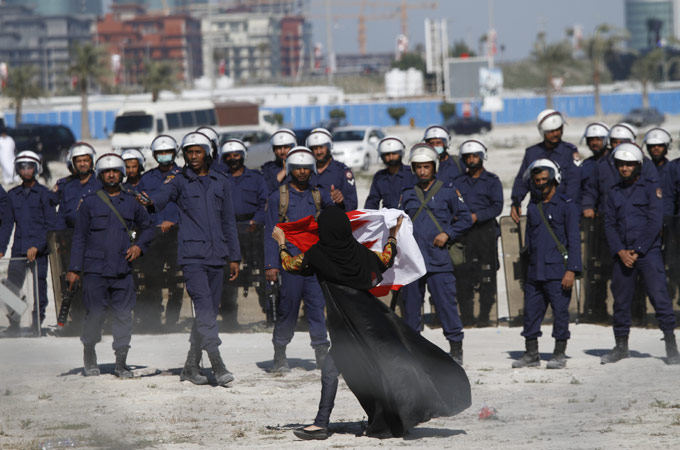
via IPS News
The special session of the Bahraini National Assembly held on Sunday Jul. 28 was a spectacle of venom, a display of vulgarity, and an unabashed nod to increased dictatorship.
Calling the Shia “dogs”, as one parliamentarian said during the session, which King Hamad convened, the Al-Khalifa have thrown away any hope for national reconciliation and dialogue.
The 22 recommendations approved during the session aimed at giving the regime pseudo-legal tools to quash dissent and violate human and civil rights with impunity. All in the name of fighting “terrorism”.
Watching a video of some of the speeches during the session, one is saddened by how low official political discourse has become. Students of Bahrain yearn for the days when parliamentary debaters were civil and when Shia and Sunni parliamentarians engaged in thoughtful, rational, and tolerant debates despite their political or ideological differences.
In the early 1970s when the Constituent Assembly debated the draft constitution, Bahrainis followed the speeches by their elected and appointed representatives with much respect and hope for the future of a modern, tolerant, and civil society.
Such parliamentarians as Rasul al-Jishi, Jasim Murad, Ali Saleh, Abd al-Aziz Shamlan, Ali Sayyar, Isa Qasim, Qasim Fakhro, and others made their countrymen proud with the quality of debate that characterised Bahrain’s first ever elected parliament.
Even such ministers as Muhammad bin Mubarak al-Khalifa, Ali Fakhro, and Yusif Shirawi participated in those parliamentary debates and worked jointly with elected members to chart a more hopeful future for all the people of Bahrain.
As I sat through those parliamentary sessions in 1973 and followed the lengthy discussions on a myriad of constitutional amendments, I envisioned a democratically prosperous Bahrain for years to come. The National Assembly, however, was dissolved two years later, and the constitution was suspended. Al-Khalifa ruled by decree ever since.
The parliamentary special session last Sunday showed a divisive, intolerant, and fractured country that is rapidly descending into chaos. It’s as if civility, rationality, and moderation have become relics from the past.
King Hamad and the Crown Prince welcomed the recommendations, and the powerful prime minister urged his ministers to implement them immediately; in fact, he has threatened to fire any minister who slows their implementation.
According to media reports, the recommendations were prepared before the meeting and were disseminated to the media a few minutes after the session ended. They were not even debated meaningfully or rationally during the session.
The regime’s fear that Bahrainis would have their own “tamarud” (rebellion) civil disobedience movement to confront the regime on Aug. 14, Bahrain’s actual independence day, drove the timing of the session. The Bahraini opposition hopes to emulate the Egyptian “tamarud”, which indirectly led to Morsi’s removal.
Like other autocratic regimes, whether under Abdel Fattah al-Sisi in Egypt or Bashar al-Assad in Syria, Al-Khalifa justified the draconian recommendations against all forms of opposition and peaceful dissent in the name of fighting “terrorism” and incitement of “all forms of violence” (Recommendation #3). The regime will likely use these recommendations to ban all peaceful demonstrations and protests.
The regime is prepared, according to Recommendation #2, to revoke the citizenship of Bahraini citizens “who carry out terrorist crimes and those who instigate terrorism”. The regime defines a terrorist as any Bahraini who is suspected of being a dissident or actively advocating genuine reforms. In fact, Recommendation #6 bans “sit-ins, rallies and gatherings in the capital Manama”.
The regime does not seem perturbed by the fact that citizenship revocation violates international legal norms and the Bahraini constitution. In fact, this might be a sinister way for the Sunni al-Khalifa to alter the demographics of the country by depriving the Shia dissidents of citizenship.
Viewing the entire protest movement through the security prism, as the recommendations imply, the regime seems bent on escalating its crackdown against peaceful protest and freedoms of speech and assembly, according to the Bahrain Centre for Human Rights.
Under Recommendation #7, the country could soon be ruled under martial law or “National Safety”, as the regime euphemistically calls it.
The recommendations have put the country on a sectarian collision course, have dealt a major blow to peaceful dissent and civil rights, and have raised serious questions in Washington about Al-Khalifa’s commitment to genuine reform.
In a direct rebuke to U.S. Ambassador Thomas Krajeski, Recommendation #11 requests “that all ambassadors to Bahrain to not interfere in the kingdom’s domestic affairs.”
Some die-hard Sunni parliamentarians, with the support of the Royal Court, have urged the regime to expel Ambassador Krajeski from Bahrain, claiming he has been meeting with pro-democracy Shia dissidents. Others have threatened his personal safety.
Still others, with tacit regime support, are hoping the ambassador would be transferred out of Bahrain, much like what happened to political officer Ludovic Hood in May 2011.
At the time, according to the “Religion and Politics in Bahrain” blog, pro-regime Sunni activists demanded Hood’s removal because they claimed he offered “Krispy Kreme doughnuts to demonstrators who had gathered outside the American Embassy” to protest perceived U.S. support for Al-Khalifa.
Now pro-regime Sunni activists are feverishly campaigning against the U.S. ambassador’s public support for human rights and genuine reform in Bahrain. The recommendation curtailing diplomatic activities in the country is squarely aimed at Ambassador Krajeski.
According to Bahrain Mirror, some have advocated banning him from appearing on state media and in pro-regime newspapers, even if the subject he is discussing is gourmet cooking, one of the ambassador’s hobbies!
The anti-Shia and anti-reform underlying theme of the recommendations is a naked display of tribal family autocracy, which Al-Khalifa are determined to preserve at any cost, including tearing the society apart. Adopting these recommendations reflects the regime’s nervousness about the ever-increasing precarious nature of their rule and the unstoppable demands for justice, dignity, and equality.
According to a recently leaked audio recording, Crown Prince Salman was quoted as saying, “The current situation is unsustainable, and the policy we are pursuing cannot continue. People are getting tired, and conditions could worsen any moment. Bigger dangers are threatening our society, and the future is becoming more precarious.”
Washington and other Western capitals should work diligently to disabuse the king and the prime minister of the notion that “securitisation” is the answer to Bahrain’s domestic ills. Engaging with the public on the future of Bahrain, including the Shia majority and the pro-democracy youth movement, is the only way to bring the country back from the brink.
Washington should make it clear to Al-Khalifa that media attacks and threats against Ambassador Krajeski should stop. Whipping the flames of hatred against the U.S. embassy to preserve the regime’s dictatorial rule is a dangerous game, which Al-Khalifa cannot afford to engage in.
As a first and immediate step, King Hamad should muzzle the hotheads in his Royal Court and in the prime minister’s office. In the meantime, the U.S. should initiate serious discussions on how and when to move the Fifth Fleet out of Bahrain to a neighbouring country or over the horizon.



I deeply apologise Norman if I offended you in any way because it was never my intention. I am a grandfather too, though a relatively young one if I might add. My objective is bringing analysis and objectivity for the purpose of enriching the debate, thus never meant to be personal and never would as I believe it defeats objectivity. I strongly believe the future is nothing but an extrapolation of the past. We are creatures of habit and inevitably people are judged by their intentions and actions and not by their rhetoric.
I found Bader’s speech quite rhetorical with not much substance. He might be young but at this stage of history of Islamophobia, the elders, both Sunnis and Shias, speak the same language too. It’s a religious conflict and not secular, and by no means it’s generational.
As far as I am aware Norman, you just happened to be one of those people we are accustomed to see every now and then preaching on a deeply rooted conflict (probably 1400 year old) without being sufficiently qualified. I found Emile Nakhleh’s article fitting this category as well. Forgive me Norman it’s not personal.The one and most destablising factor in Middle Eastern and world politics, and Bahrain in particular, I repeat, are probably those novice snobbish western politicians and researchers, in particular those calling themselves experts on foreign policy with just a couple of books and few publications in their bags, in preparation of course for the more senior ones who are known to have made a mockery of international politics with their flawed policies, referring to the era of Bush, Blair, Aznar, Powell, Rice, etc. Dr. Rice was known to be an expert on Russia. For your information todays Russia is far more stronger than the one got fragmented in 1990. They have regrouped. We are back to cold war.
Was reading few days ago that Dr. Martin Indyk was the new “Peace Envoy” to Palestinians and Israelis. Dr. Indyk is Jewish; Australian citizen; ex Ambassador to Israel; Deputy Research Director of AIPAC; author of Dual Containment Policy (aimed against Iran and Iraq). Talk of an honest broker for peace. What I am trying to say is that we don’t take everything we read or listen to for granted. This issue of substance and credibility is central to the cause.
One must also appreciate that present day politics is driven principally by tainted and manipulated media material. I believe Egypt’s Mubarak was toppled by the media. Same goes for Iraq’s Saddam Hussain, Libya’s Qadafi, Tunisia’s Bin Ali and last but not least Egypt’s Morsi. I thought Bader’s writings were fitting this category with his grand disinformation of “Advisor to the King being imprisoned”.
It’s this tainted and manipulated media that is fueling the loose rhetorical talk of freedom, justice, democracy, dialogue, reconciliation, etc., while in reality there are other agendas and objectives, in a precise manner with what happened in Iraq.
Bahrain is a constitutional monarchy with the two chamber system with an overwhelming vote of 98.4%. Bahrain constitution has the approval of more than 55%. The 22 anti terror recommendations were the output of a legitimate parliamentarian system with the objective of bringing peace and security to the country. Just in case one wants to differentiate between the villain and the victim, just ask who drew first blood.
Of course Bahrain has problems but then who hasn’t. The right venue to voice out grievances is the parliament and not going on the rampage of arsons, killings, destroying public assets, etc. The Shia political opposition of Alwefaq are welcomed to take part in the democratic process again after they withdrew from the parliament in February 2011 when they opted to ride the more lucrative Arab Spring wave in the hope of achieving other ulterior objectives of toppling the 250 year old of Alkhalifa rule owing to the vastly flawed eccentric myth that they better deserve to rule Bahrain.
Mr. Abdul, Apologies accepted. That said, your tone hasn’t changed, since you launched into the same rhetoric that is on the negative side. You seem to have a predisposition of doing so with anyone who doesn’t agree to your train of thought. I am but an observer here, trying to understand what is taking place in Bahrain, which both you & Mr. Bader provided, but your tone as I say, negates your apology when you proceed to attack me as you did in your 8-10-13 post, comntinuing into today: 8-11-13. Perhaps it’s because, as you say, you’re a Grandfather, though younger than MOI, so you’re set in your ways, refusing to move on from the past, which though you make a distinction between a religious/political stance, you don’t seem to like the fact that Mr. Bader, because he stated his age of 19 years, could have the maturity and the ability to see the fault lines that have produced the stalemate. Fresh thinking on the subject is what is needed, not rehashing the past. If my saying/agreeing with Mr. Bader in this context makes me a “novice” in your eyes, then IMHO, your position is one who refuses to except that his views are passe, but not meant to be offensive to you. Of course, if you feel I’m being unfair or insulting you, I apologize in advance, for that’s not why I’m answering you in this matter. Respecting others views, even if they are radical, is good common sense. That doesn’t mean that yours do not have merit, but resorting to negative rhetoric doesn’t bring people to the table, it just keeps the same old pot brewing, which doesn’t solve the problem at hand.
Mr. Bader, I again have to say, at your young age of 19, you exhibit the maturity of one much older, refreshing to say the least, as well as giving hope to not just MOI, but to everyone in the M.E. This might sound like a tall order, but I believe it’s the only solution to the problem plaguing the stalemate in the M.E. I will add also, that the meddling Western Governments need to withdraw, both in physical form as well as trying to dictate the agenda. One only has to look at the M.E. and what has taken place, to understand what I am saying. I won’t point fingers, as the cast of characters are well know to everyone, as are their true motives, though I will say this, the present course/thinking is a failure, meaning that not taking advantage of the youth, who have the energy, vitality, intellect, could create a real powerhouse in the M.E. in more ways then one can imagine.Perhaps that’s the reason they continue with their destructive agenda, more out of fear that they can’t control it. The Western powers, along with the old way of thinking of the different inhabitants in the M.E., are what’s keeping “PEACE” from being achieved. I include Mr. Abdul in this view of the old way of thinking, not as a slight to him, but he has been vocal in the negativity toward both you & MOI. I have addressed his latest comments, so I won’t repeat them. Thank you again for your input, as well as you understood what I had said, for what you bring to the table, is different, encouraging. As an old entrepreneurial businessman, I would like to share one of the many pearls learned over all these years, “give a person enough rope, that person will either go climb a mountain or hang himself”, as a way to judge whether that person is loyal or would betray.
Thanks Bader for the correction on the use of the term Islamophobia. I appreciate it very much. I sincerely do. I must admit I often get confused with these Islamic terms that have evolved in recent years, e.g. Islamacising Politics, or Politicising Islam, Islamophobia, Political Islam, and many more I guess. What I meant of course was the use of Islam to propel and furthering political goals and agendas.
I think Bader you mentioned in some of your earlier comments that (i) you weren’t familiar (or may be wasn’t conversant) with the 1973 Bahrain constitution, (ii) you weren’t familiar (or may be wasn’t conversant) with 2002 Bahrain constitution, (iii) you weren’t familiar (or may be didn’t know of the National Action Charter of 2000, and now I learn (iv) you are not aware of the events of the Pre and Post 1979 Iranian Revolution. I am also assuming here that you are not aware of the (v) 1970 referendum; or the (vi) 1974 labour unrest; or the (vii) 1965 labour unrest; and of course the (viii) circumstances that lead to the creation of the November 1956 National Union Council. May be you are 19 Bader after all. My apologies therefore.
It seems Bader your knowledge of political history of Bahrain is somewhat modest, although in one of your comments your referred to the 1920s political movements, though now not sure of the purpose of throwing that piece of information. I am barely trying to stay away from using superlatives you might find offensive.
I gather Bader with the way you want to proceed with this debate is to put everything behind us and look forward to the future. I couldn’t agree more Bader. I love to have a bright future for everyone. I think this is the perfect solution for the Arab Israeli conflict which is nothing but a historical conflict. I love to leave everything behind me and focus on the future, and in the process of course, you are in a way proposing to eliminate the role of history completely. I couldn’t love this approach more Bader, but then are we being realistic here? would this not be a wild goose chase? For your information Bader Political Science is nothing but a study of History.
By putting historical events and dates behind us I am assuming that you want me to take Alwefaq at face value and vice versa for Alwefaq to take me at face value. Are we being realistic here Bader?
The 1979 Iranian Revolution was a decisive moment in the Shia doctrine and the Gulf politics alike. Post 1979 Iranian Revolution Shias turned out to be completely different to those Prior. The whole mindset changed. The 1979 Iranian Revolution produced Khomeini who came with the Welayat Faqih doctrine. Welay Faqih teachings are that Khomeini was the agent or a proxy of the “awaited Mahdi” or “emergence of Alhijja”, which in literal terms meant Shias would basically treat Khomeini’s instructions as those coming from “awaited Mahdi” or “emergence of Alhijja”, i.e. from God, technically speaking. Khomeini passed his privileges to the now Supreme Spiritual Leader Khamenaei.
You seem to like Wikipedia Bader. Try to extract information about Bahrain history from the 1920s and 1979 Iranian revolution, Welayat Faqih or Alwali Alfaqih as also often used, and we will have another session then.
My sincere wishes and apologies to everyone.
Let me just say that I think the way the conversation has progressed in the last two comments is fantastic! Its great to see that we’re able to speak to each other in a civil manner regardless of what was previously said.
I do not think ill of you Mr. Aagool, I just had problems with the way in which you were trying to debate. I believe that I have benefited from this conversation.
Furthermore, to Mr. Norman: Thank you very much for your positive attitude and willingness to read and listen and learn positively from everything that was said whether or not some points were disputed or presented negatively. Thank you once again for your kind disposition towards both myself and Mr. Aagool.
These kinds of resolutions are what we need: deep, critical, civil conversations about problems with recognition for the sincerity and seriousness of each side’s claims and opinions. This is the kind of debate that I hope will take place.
To Mr Aagool thank you for putting aside some of your issues with my comments and deciding to move forward with this debate. I greatly appreciate it.
Furthermore, yes, when it comes to many of Bahrain’s constitutional and legal frameworks, I am unfamiliar with most of them except perhaps contemporary laws regarding cyber security, freedom of press, expression, and other forms of public discourse.
I am only generally familiar with Iranian history post-WW1 up until the end of Iran’s war with Iraq. However, I do not know anything about the effects or the role that Iran’s Islamic Revolution in international politics other than the fact that the world turned on its heels and started viewing Iran as an enemy.
However, now that you explain the Welayet Al Faqih and how it related to Shia’s views on Mahdi Al Muntadhar, I can start to understand a little bit more about the way Khomeini is viewed and regarded by religious Shia’s. Thank you very much for this information, I can now start to look more into it.
Moreover, when it comes to the 1970 referendum, the 1974 labor unrest and the 1956 National Union Council, I do know a moderate amount of information about it, but I do not claim to be well-versed in this history. We are not taught it in school, and many books on the subject were banned in Bahrain before 2002. A few of which still are. I have many conversations with family and peers about the negative impact this has on young people who did not experience these events and therefore do not have historical background on the frequency of Bahrain’s national resistance movements. I mostly know about the national resistance movements that took place in the 150’s and 60’s because my grandfather was a leading figure and was one of the individuals deported from the country. Some family members tell me about their experiences related to this, but other than that I do not know many of the political details other than the fact that Bahrain’s British governor controlled many branches of the government. Furthermore, I apologize for throwing in that comment about the 1920’s. When writing it, I hesitated saying it because I did not know enough about it to debate the details nor did I want the debate to veer away from contemporary Bahraini politics.
It is interesting that you mention the Arab-Israeli conflict because I advocate the same “future” approach with that issue, as well. However, I do not necessarily advocate throwing history away, that would be disastrous. I advocate (1), recognition of history and past mistakes made, (2) make sincere apologies for this and extend an offer to reconcile with the past, (3) try to come to an understanding over how one can make up for past mistakes, (4) plan for a long-lasting peace in which all sides are satisfied in terms of the past, present AND future.
It sounds idealistic, I know but I genuinely believe that its possible. I also believe it offers better opportunities than what is currently being advocated. It is very difficult, all conflict resolution is, but if there is genuine WANT and intent to have peace, then I believe this can be achieved.
If I may mention a few non-Bahraini examples, this approach worked for the United States to solve problems in the Jim Crow South during the 1950’s and 60’s. Racial conflicts still exist. But MAJOR steps have been achieved since then. Peace and reconciliation can sometimes be an ongoing process ESPECIALLY when there is a long and deep history. I think that this is true for Bahrain, as well, but people first need to take the first step. The radical elements of the oppositions and the radical elements of the government BOTH need to stop what they are doing and genuinely question whether their actions are better for the future of Bahrain. Because so far, the real losers are the common people who have to go through security checkpoints, try to avoid burning tyres, have their property damaged, their businesses vandalized, their physical, emotional and mental health in deteriorating condition, people being arrested and convicted arbitrarily, people not being able to see their families whenever they wish, and so on and so forth.
It can work, but only if people really WANT it to work. I’m one of those people and thats why I advocate this approach whenever political conflicts in Bahrain are brought up.