by Robert E. Hunter
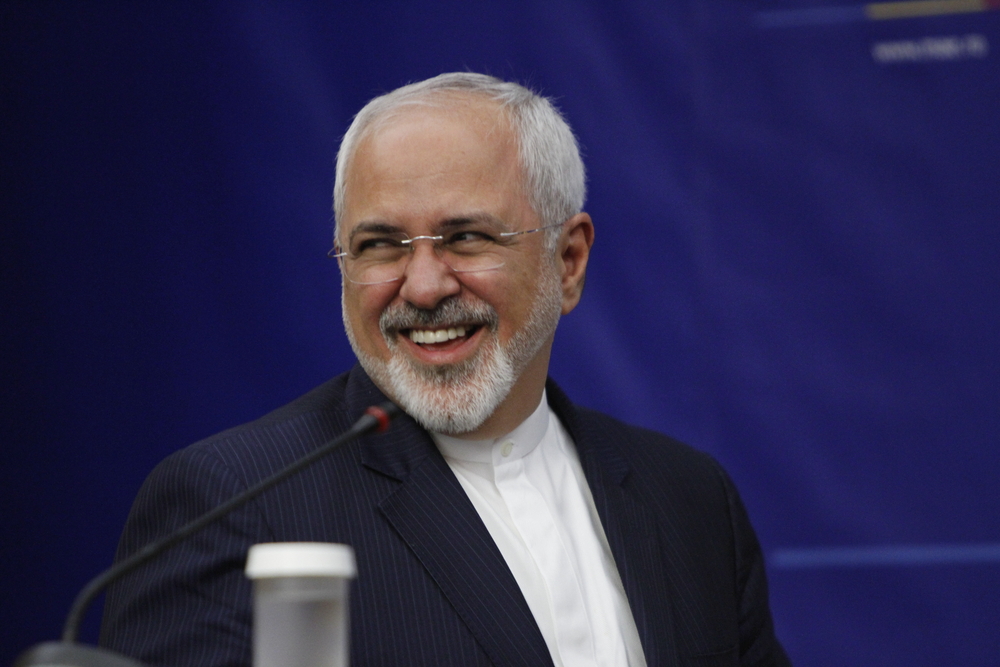
In the latest tit-for-tat in the battle between the United States and Iran, this week the Treasury Department, at the behest of the State Department, imposed sanctions on the Iranian foreign minister, Mohammad Javad Zarif. This follows Donald Trump’s June 24 Executive Order 13768, which imposed sanctions on Iran’s Supreme Leader, Ali Husseini Khamenei.
Sanctioning Khamenei is of no consequence, since he obviously is not planning a trip to the United States or any other form of intercourse with it. Not so with Zarif. In the first place, it is most unusual to place the chief negotiator for an unfriendly (or even enemy) nation on the “unwelcome” list. It is a direct violation of accepted diplomatic practice, going all the way back to the Greeks a few thousand years ago, as well as of Article 31 of the 1961 Vienna Convention on Diplomatic Relations, which governs the way in which countries agree to treat foreign diplomats. Of course, the Islamic Republic of Iran has been guilty of even worse behavior toward the United States. On November 4, 1979, it imprisoned 52 American diplomats and other employees of the U.S. embassy in Tehran for 444 days. U.S. sanctions against today’s Iranian leaders are just desserts, by comparison—taps on the wrist.
So why do it? If Trump does want to open negotiations with Iran, as he repeatedly says, this act weakens even further those within the Iranian political struggle who would like to see some way out of the current crisis with the West, as opposed to hardliners who seem indifferent to the risks that they are running. The hardliners’ behavior could even lead to the destruction of Iran, whether through war or, more likely at this point, through the collapse of its economy and perhaps even the splitting up of the country. Indeed, following in the footsteps of Ayatollah Khomeini, the current religious crowd are acting as parasites on Iran, without concern for the consequences to the host body.
Zarif has done his share of tongue lashing of the United States, especially of Trump and his uber-hawkish national security advisor, John Bolton. Thus, some pushback is nothing special. By contrast, one view in the Trump administration is that Zarif is really of no account in the actual Iranian power structure—which is probably true—so no damage is done if he is sanctioned. But then what’s the point of doing anything to him?
Trump, Bolton, and Secretary of State Mike Pompeo, another hawk on Iran, clearly see every step they take against the Islamic Republic as part of the campaign of “maximum pressure.” While Bolton has made no secret of wanting war and Pompeo may agree, supposedly Trump doesn’t want to go that far. That is wise, given the almost certain damage that a war or even just a collapse of Iran as a single country would do throughout the Middle East, including to all of Washington’s regional partners and allies.
Further, Trump and Company almost surely decided that “something more had to be done,” following several recent incidents regarding shipping. Britain seized an Iranian oil tanker, the Grace 1, off Gibraltar, reportedly at U.S. request, as the ship was supposedly violating EU sanctions against supplying oil to the Syrian regime of Bashar al-Assad. After Iran responded by harassing some British vessels in the region of the Strait of Hormuz and then seizing a British tanker, the Stena Impero, Britain dispatched a couple of naval vessels to the Persian Gulf. Further, the new UK prime minister, Boris Johnson, is determined to appear decisive on all fronts. He will be pressured to act to protect freedom of navigation to and from the Persian Gulf. Washington’s efforts to cobble together a group of NATO nations to provide some such protection, however, have not achieved much to date. Indeed, other European states are deeply worried that the current crisis will just get worse, and these worries are shared by everyone involved in the global oil trade. Even without physical blockage of shipping, attacks on oil tankers would overnight send insurance rates steeply upwards. In Israel, as well, whose prime minister, Benjamin Netanyahu, has been the hawk’s hawk on Iran, officials have become uncomfortable with the course of the crisis.
Lost in all the talk about Iran possibly trying to close the Strait of Hormuz is the fact that Tehran is as dependent as anyone else in the world on the free flow of hydrocarbons. Indeed, given crippling US economic sanctions, it may have the most to lose from any disruption in oil traffic.
The Trump administration likely has some other motives for the “dust in their eyes” sanctioning of the Iranian foreign minister. For one thing, Iran has increased its enrichment of uranium, though modestly; this was, in fact, a long time coming, given that it has been more than a year since Trump withdrew the United States from the 2015 Joint Comprehensive Plan of Action (JCPOA). That agreement had effectively trammeled any possible Iranian efforts to get develop a nuclear bomb and was the most significant U.S. geostrategic achievement in the Middle East since the 1979 Egypt-Israel Peace Treaty.
Another reason may well be the fact that Zarif, who studied for years in the U.S. — he holds a PhD from the University of Denver — and whose American English is impeccable, has been a particularly effective spokesperson for Tehran. He’s been notably successful with members of the U.S. foreign-policy establishment, which he has long cultivated not only as foreign minister, but also as his country’s ambassador to the United Nations from 2002 to 2007.
Still another is that Bolton and Pompeo pressed for sanctioning Zarif in a very deliberate attempt to strengthen even further hardliners in Iran who may themselves be spoiling for a fight, thus increasing the chances that Tehran will take more provocative steps that will have the effect of persuading European leaders to side with Washington. Or Bolton/Pompeo might just want to show toughness at a moment when they’ve lost the internal fight in the administration over whether to renew sanctions waivers for those countries that are cooperating with Iran’s civilian nuclear program, consistent with their JCPOA obligations.
What the U.S. has done regarding Zarif is also consistent with Trump’s standard tactic of trying to change the subject when he gets into trouble. The U.S. Congress has just passed legislation halting the supply of weapons to Saudi Arabia for its conflict in Yemen—characterized by the United Nations as the world’s worst humanitarian crisis—in which the United States (along with Britain) has been deeply engaged through a wide range of support activities. This vote, including a majority in the Republican-controlled Senate, was embarrassing to Mr. Trump, notwithstanding his veto (which has just been sustained).
While it can still be possible for some diplomatic approaches to bear fruit, and there has been a lot of talk by Trump, sanctioning Zarif doesn’t help. It sends a bad message. It also further alienates the United States on this issue from its European allies (save perhaps Boris Johnson’s Britain with his compelling need, with Brexit looming, to cozy up to the United States). They are deeply opposed to war with Iran and are firm supporters of the JCPOA.
The Trump administration is obviously still betting that tightening the screws on the Iranian economy will eventually cause its regime to “cry uncle,” if Bolton and Company can’t get what is obviously their goal—although the U.S. denies it—of regime change. Oddly, the U.S. strategy just causes the “average Iranian” to resist external bullying, a common trait in almost all countries. For their part, the Iranians clearly are betting that fear of war will lead Washington’s allies to press the Trump administration to back off. Unfortunately for everyone, unless one or both are bluffing—for which there is no evidence on either side—one or both bets could be lost.
At heart, the U.S.-Iranian crisis is artificial, at least in terms of core U.S. interests. The JCPOA effectively took care of most of America’s strategic business in the region. Unfortunately, while lifting nuclear-related sanctions and thus technically keeping its part of the JCPOA bargain, the Obama administration not only maintained other sanctions that were not covered by the agreement but, more important, simultaneously imposed new ones, thus losing the chance for exploring whether the JCPOA could lead to serious negotiations on other matters of concern to outsiders. These include the Iran’s ballistic missile program, which is troubling but was not made illegal by the agreement. Maybe the Iranian clerics would not have been interested in any such further negotiations, but we will never know.
What we do know is that this week, through one small symbolic action, the Trump administration removed from play the one Iranian with a proven track record of working effectively with outsiders, including the United States. This makes matters worse and reduces the chances of ending the U.S.-Iranian Mexican stand-off that should never have taken place.
Further, and not immaterial, the United States is a big and powerful country which has been respected for so long around the world, while the Islamic Republic has never had more than a tiny handful of friends and little respect. Whatever else is involved, the Trump administration’s actions this week are unworthy of a great nation and further damages its reputation. And that is a high cost, indeed.

Mr Mostofi
You had better keep yourself busy listening to Sinatra.
@Hassan Amini,
Well said.This monkey behavior like business is not their own show! It is really a behavior of monkeys following the orders given to them by their masters in the ME. Sorry I didn’t mean to compare monkeys to these war mongers especially “Father Pompeo and Janny B”
Hassan Amini
In Saudi Arabia Trump proclaimed himself nowkar of Sunni Arabs and enemy of the Shia.
Later, he proceeded to sanction Ayatollah Khamenei, reminding me of actions of Reza Shah and Mohammed Reza Shah, and Saddam Hussein.
He also proceeded to destroy US political positions that afforded some modicum of plausible neutrality over the War for Palestine; replacing them with an explicit declaration of fealty to Zionist Judaism against Islam.
Americans must decide if they are inheritors of the Enlightenment Tradition or of Dissenter Puritanism. But they can no longer hide or otherwise avoid staring at that choice.
Being an Eternal Pessimist, I am inclined to predict that Puritanism will prevail in this case too and the United States will persist on fighting a religious war against enemies of Israel for many more decades.
FYI
Thank you. You are quite to the point. I could not conceptualise the Trump attitude towards Iran so well as you have done because you’ve revealed that what I’ve referred to as hatred has a much deeper roots: you name it “a religious war against enemies of Israel for many more decades.” But I personally don’t have such a religious bias. As a Muslim, I have been taught that I should not be biased, that Sunnis and Shiites are brothers and that Jews and Christians should be respected. Anyone thinking of a “religious war” you’re talking about suffers from a feverish mind. If you hold Trump as your model who will fight your enemies, Muslims can fight back in the name of Allah. But I don’t think they are to fight a religious war at the moment. What I think they are inclined to is get the world rid of liars, cheaters, racists that may rule in any name, religion and ideology. You may label it as Enlightenment from your own perspective and support Puritanism instead. But I am of the opinion that your Puritanism results from a feverish mind that comes out of Hell.
Hasan Amini
In Peace, young men bury the old, in War, the opposite.
One must then admit that one is at war, events at Christchurch this past March and in Sri Lanka this past April point to a war between Islam and Christianity. And before that various and multiple attacks in Europe against those countries percieved to be enemies of Islam, i.e. UK, Spain, France, Belgium as well as against the United States.
The wars in Yemen and in Syria are wars of Sunni Muslims against the Party of Ali. Shia from Iran, Lebanon, Afghanistan, and Pakistan have been fighting against Sunni Muslims coming from all over the world to destroy the Syrian Arab Republic, an apostate government they claim.
And the war over and in Palestine has Zionist Judaism & Anglo-American Old-Testament-Besotted Protestants fighting all of Islam.
These are facts and not figments of a feverish mind. I never put much stock in Muslim Unity, I see no use for Sunni Islam, all I see is that Iran and her alliance members are subject of attacks by chaotic Sunni Muslims who are too stupid to realize that they are fighting against the central state of their civilization; that without the Shia Islan and Iran, there could be a religion called Islam, but never a civilization.
And the Americans, they think they have identified their Good Muslims, the neo-Salafis, who will help them defeat the Shia and usher Israel into a golden age of Jewish-Muslim Comity and Amity.
They cannot see a religious war even the one they themselves have done so much to instigate.