
by Shireen Hunter
For some time now, most Middle East states and a good number of Western countries have portrayed Iran as the main cause of problems in the Middle East and parts of South Asia. Iran emerges from this narrative as the world’s biggest sponsor of terrorism and, in general, an all-around source of evil.
The United States, in particular, has tended to blame all of its setbacks in the Middle East and Afghanistan on Iran. If America’s plans for Iraq did not pan out it was because of Iran, if the Syrian war is not going the way it was intended the fault is Iran’s, if Saudi Arabia is leveling Yemen it is because of Iran, and so on. In Afghanistan, the US does not blame its setbacks on Pakistan and Saudi Arabia, which created and have sustained the Taliban, but Iran.
This perception of Iran as behind every trouble in these regions implies a degree of power and influence that Iran absolutely lacks. Any clear-headed analysis of Iran’s material power—economic, military as well as its so-called soft power—will demonstrate that it does not have any great influence over regional developments. Rather, any influence that Iran might have gained has been largely the outcome of Western mistakes, including a disregard for the ethnic, religious, and political realities of the region.
Take Syria, for example. President Bashar al-Assad would have been willing to abandon Iran if Israel had been willing to compromise on the Golan Heights. In fact, Assad said so many times although perhaps not exactly in such stark language. In Iraq, a government that is supposedly run by Iran refuses to accept the 1975 agreement that settled the issue of the contested waterway of Shatt al-Arab. Among other indignities, Iraq refuses to deal with sand storms that are choking Iran. In Turkey, Iran is called the Persian Satan. Afghanistan refuses to pay Iran’s water rights, thus turning the legendary Hamoon lake into a desert. Iran educates hundreds of thousands of Afghans at great expense and and many work in the country, legally and illegally. Yet Afghanistan’s press attacks Iran, and its government refuses to cooperate on many border issues, including the presence there of groups hostile to the Iranian government.
So, if Iran is so powerful, how can everyone blame, demonize, and scapegoat Iran without paying a price? The simple answer, and the one most frequently offered, is that the Islamic regime is the culprit. True, the behavior of Iran in many areas leaves much to be desired, and it no doubt has greatly contributed to the current conditions. However, this answer is not quite sufficient.
Even before the 1979 revolution, the West in particularly tended to magnify Iran’s faults while ignoring or soft-pedaling the shortcomings of other Middle East states. Gamal Abdul Nasser’s invasion of Yemen did not even receive a slap on the wrist. But when the Shah tried to help Oman fight the Dhofar rebellion, Persian imperialism was allegedly on the march. When the Shah celebrated the 2,500th anniversary of the Persian monarchy, he was accused of a folie de grandeur, although most of the money was spent not on the event itself but on infrastructural projects such as roads and hotels. Yet the billions of dollars that Persian Gulf princes and sheikhs spend on personal luxuries barely received a mention.
Iran’s Cultural Isolation
Despite invasions by the Greeks, Arabs, and a variety of Turko-Mongol armies and the ensuing losses that reduced the country’s Persian core, Iran was not Hellenized, Arabized, or Turkified. On the contrary, Iran’s Arab and Turkic invaders largely became culturally Persianized. As Ada Bozman has said if “Islam conquered Iran, then Iran conquered Islam.” Iran also retained its separate language and culture and, by embracing Shiism, carved out its own unique place within Islam. But Iran has also paid a price: loneliness. In its neighborhood Iran has no natural allies or ethnic kin. Those who are closest, like Afghanistan and Tajikistan, are separated by religion while those who are close by religion like Iraq and Azerbaijan are separated by ethnicity and language. This loneliness also means that one can mistreat Iran without having to face opposition from other states. There is no League of Persian States that would come to Iran’s rescue. Because it is Shia, the Organization of Islamic Cooperation also will not help Iran or protest when it is mistreated.
Meanwhile, Iran’s value to major international players has been derivative: it has been useful in achieving other goals or serving as a buffer and not as an ally for whom one would assume responsibility. Sir Dennis Wright, the one-time British ambassador in Tehran in the 1960s, wrote that Britain never considered Iran of sufficient value to colonize it. British policy was to keep Iran moribund and deny it to Russia. America essentially followed the same policy. The United States did not sign a security treaty with Iran and gave it less money than even to Nasser’s Egypt, which at the time was flirting with the Soviet Union. America has also been much more willing to experiment in Iran than, say, Turkey or Saudi Arabia, as it did both under John Kennedy and Jimmy Carter administrations. Much of the turmoil of the 1970s was the result of the drastic, highly controversial, and quickly implemented reforms in the 1960s in response to America’s urging. The Shah thought that he would lose American support if he didn’t attempt the changes. By and large, Russia too has had the same attitude towards Iran, except when Stalin tried to turn Iran into a constellation of Soviet Republics in the shape of current “Stans.”
Iran is both too big and too small. It is too big for the comfort of both its neighbors and the great powers. At the same time, it is too small to deter aggression. Iran is no China or India whose sheer size inhibits aggressors.
Iran’s Geopolitical Challenge
Iran’s geopolitical predicament, and the fact that it is blocked both on its eastern and Western fronts, means that any Iranian effort to escape its confinement prompts accusations of expansionism or imperialism. When Saddam Hussein, before Kuwait’s invasion, was sabotaging the Gulf Sheikdoms nobody called that “illegitimate interference.” But Iran cannot even have a school or a mosque in Bahrain without begin accused of terrorism.
As Napoleon said, “Geography is destiny.” But one can mitigate one’s geographic, and in Iran’s case, cultural misfortune. Given its predicament, Iran needs an essentially nationalist, self –contained, pragmatic, and non-ideological approach to foreign policy. . It needs to avoid entanglement in others’ disputes, especially when its direct security interests are not threatened. It may not be able to avoid some entanglement in the Persian Gulf, given that some regional states are interfering in Iran itself and the Persian Gulf is vital for Iran’s security. But it should not become embroiled in disputes in the Levant such as the Arab-Israeli conflict. Iran needs to have good relations with all major players so that regional players cannot manipulate its difficulties. In this context, its refusal to deal with America is highly destructive. If Iran wants to voice its concerns, it should do so through accepted international fora.
Sadly, the likelihood that the government in Tehran will heed this advice is nearly zero. On the contrary, since the revolution, Iran’s foreign policy behavior has done nothing but exacerbate its geopolitical predicament. The current government’s distorted priorities, which emphasize vague and unattainable Islamist goals instead of focusing on the country’s survival and prosperity, has brought Iran to the point when just about everybody uses and abuses it for their own selfish purposes and no one raises its voice to defend it.


JW – – Yes, a bit of posturing takes place. Boosting morale. But Hezbollah is not a threat to the US and will be highly unlikely to attack Israel, unless Israel attacks first.
James, I don’t think you are putting yourself in Israel’s position. It is a tiny country and it usually cannot wait to be attacked, but must strike first if an attack is imminent. Because it had the strategic depth of the Sinai, it let Egypt and Syria strike first in 1973 and it was almost a disaster. With missiles and weapons, there is no way Israel will let Hezbollah strike first. It will continue to preempt by taking out weapon shipments when possible. At any time, that could trigger a full conflict.
It is very dangerous and very unnecessary. If Hezbollah is not simply a tool of Iran trying to destroy Israel but “only” a Lebanese self-defense militia, then it would be in Hezbollah and Lebanon’s interest to negotiate a peace treaty with Israel. They have no territorial conflict and the “occupation” of Palestine is none of Lebanon’s business. In fact, the Lebanese don’t like the Palestinians much, their brother Arabs, and refuse to grant them normal civil rights, but keep them in refugee camps.
But Lebanon refuses a peace treaty and Hezbollah continues to trash talk what it is going to do to Israel. There is a sickness in the Arab culture itself if the way to boost morale is to constantly threaten to attack a much stronger country with which there is no real basis for conflict.
JW Hezbollah has not forgotten the virtually insane smashing of Lebanon by Israel a few years ago. Nothing would be gained by attacking Israel and getting yet another smashing of the country.
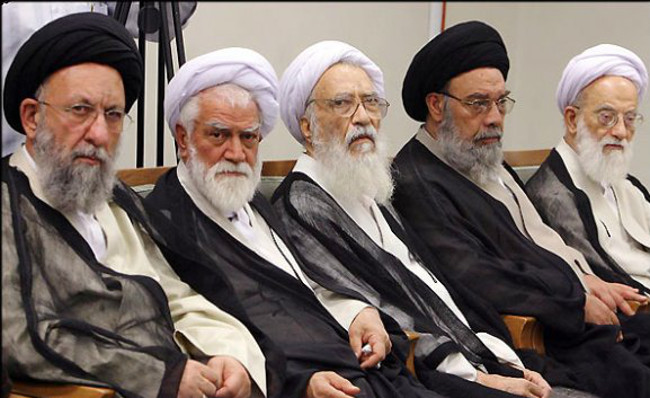
Professor hunter, I had read an article from an esteemed journalist amir taheri some years ago that described iran’s predicament eloquently. He stated that Iran as a country has no problem with any other nation and I would add, it has the potential and ability to be in the g10 countries with its human and natural resources. However,Iran as a vehicle of the khomeinist revolution, has issues with nearly all its neighbors and often find itself isolated. The stated goals of the khomeinist establishment run counter every aspect of the ordinary citizen lives and interests. These old gentlemen in the picture only represent themselves and they are not even representative of the religious population in iran. A democratic iran may still have some challenges with other countries precisely because of its potential and national interests but in a democratic society, citizen can hold their governments accountable and make informed decisions. Who can challenge the guardian council, the supreme leader, the IRGC, the foereig policy? Fortunately, revolutions end. The people of iran will be democratically ruled before we all pass away. Iran shall become iran again, a country before a revolution.
Mr Esfandi, I hope your prediction is correct or accurate! The islamists influence and indirect governing of Iran lasted for 300 years during Safavid dynasty reigning from 1500 thru 1736! So I’m not too optimistic about this regime relinquishing its power over the people soon or even in the near future! As you may know this event in the history of Iran is the third Arab invasion of Iran since many of these old men who are in charge today were either born in Iraq or grew up in the Islamic world! So the Iranians indeed have a lot of good and constructive work ahead of them.
So the Zionists also have a lot to be concerned about for the next hundreds of years!