
by Eldar Mamedov
In his inauguration speech, President Donald Trump vowed to eradicate “radical Islamic terrorism” from the “face of earth.” His top lieutenants have identified the targets of this effort. Rex Tillerson, in his confirmation testimony for secretary of state, lumped together the so-called Islamic State (ISIS or IS), al-Qaeda, the Muslim Brotherhood (MB), and “some elements within Iran”—even though Shia Iran is bitterly opposed to the ultra-Salafist IS and al-Qaeda and, to a lesser degree, the Sunni fundamentalist MB.
Trump’s inner circle – his ideologue-in-chief Steve Bannon and National Security Adviser Michael Flynn – seem to have an equally un-discerning view. As Bannon explained, addressing an audience in 2014, “I believe you should take a very, very, very aggressive stance against radical Islam … If you look back at the long history of the Judeo-Christian West struggle against Islam, I believe that our forefathers kept their stance, and I think they did the right thing. I think they kept it out of the world, whether it was at Vienna, or Tours, or other places.”
Yet, apart from such sweeping “clash of civilizations”-type assertions, this ambitious project looks remarkably scant on details. Although Bannon, for example, is very hostile to Saudi Arabia, he has never made his views on Iran known, nor is he on the record showing any understanding of the differences between Sunni and Shia. Flynn is known for his obsessive Iranophobia. And James Mattis, the Defence Secretary sometimes seen as a potentially moderating influence in the Trump cabinet, went as far as to suggest that Iran and IS may somehow be in cahoots.
Bannon and Flynn´s Islamophobia resonates strongly with the similar-minded populist nationalist parties in Europe, for whom this is one key aspect of their revolt against the “globalist elite”. But on Iran, the views seem to be diverging.
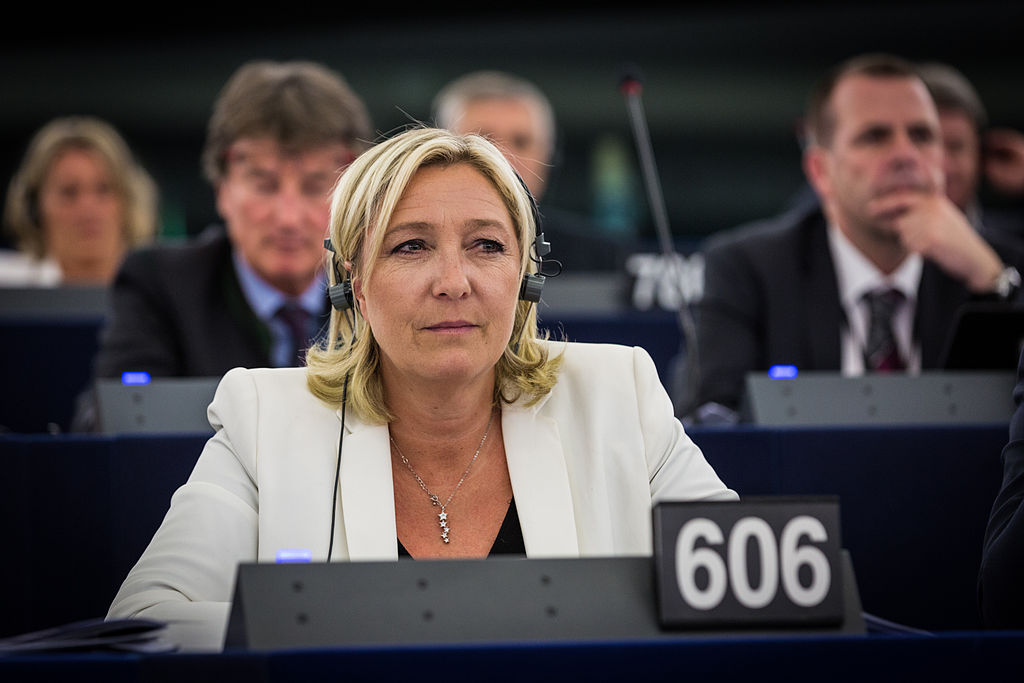
The far right’s most powerful European representative is Marine Le Pen, the leader of the French National Front and, according to the polls, one of the leading contenders for the presidency in the elections in May 2017. In her role as a member of the European Parliament (EP), Le Pen has expressed some remarkably moderate views about Iran. For example, she tabled a number of amendments to the opinion of the EP’s International Trade Committee on the EU-Iran relations after the nuclear agreement.
One of those amendments removed the original language on Iran’s “self-chosen isolation”—drafted by Marietje Schaake, a Dutch liberal known for her strong criticisms of Iran’s human rights record and regional policies—and replaced it with a statement that the nuclear agreement “makes it possible for European countries to cooperate fully with Iran, to the benefit of all.” Another amendment deplores “the EU interference in Iran’s internal affairs” and reaffirms its right “to make sovereign choices.” In the same vein, she also rejects the notion that the EU has to use its economic leverage on Iran to push for human rights agenda, warning that such an approach could be perceived as “an imposition of Western values and cultural colonization.” In yet another clause, in reference to the existing US sanctions against Iran, Le Pen urges EU member states and the Commission to defend EU companies against the “extraterritorial applications of US law.”
None of these amendments was adopted, since there is an unwritten agreement between the two largest groups in the EP—the center-right Christian Democrats and centre-left Social Democrats—not to vote for amendments tabled by members of the Europe of Nations and Freedom (ENF), the far-right group of which Le Pen’s National Front is a founding member. Instead, at a later stage the EP overwhelmingly adopted the moderate and pragmatic report on EU-Iran relations drafted by the British Labour MEP Richard Howitt, a member of the Social Democratic group.
Another far-right member of the EP, Udo Voigt from the German neo-Nazi National Democratic Party, sits on the EP delegation for relations with Iran.
Several reasons might explain the European far right’s apparent fondness for Iran. First, it should be seen as part of a populist repudiation of the “liberal globalist elite,” with its notions of universal human rights and free markets. Like Vladimir Putin´s Russia with its emphasis on “traditional values,” Iran with its system of governance and defiant foreign policy is seen as a perfect embodiment of a challenge to this “elite,” and thus worthy of support. Some European extremists adore the Iranian system precisely for the same reasons that liberals abhor it, such as the widespread use of the death penalty, which they dream of bringing back to Europe.
Second, supporting Iran can be seen as a poke in the eyes of the continental elites enjoying too cozy relations with the Gulf monarchies, particularly Saudi Arabia and Qatar, which the European political class, intelligence services, and general public increasingly acknowledge as sponsors of Wahhabi extremism and blame for terrorist attacks in Paris and Brussels.
In the end, however, the far right’s voting record in the EP suggests that for them Iran is more of an instrumental issue rather than a matter of firm convictions. For example, despite all the superficially Iran-friendly rhetoric, most members of the ENF either abstained or voted against the Howitt report (Le Pen herself abstained). Likewise, despite all the Saudi-bashing, Le Pen and two thirds of the ENF voted against the amendment calling on the EU to introduce an arms embargo against Saudi Arabia in the framework of the EP resolution on the humanitarian situation in Yemen adopted in February 2016.
This suggests that the European far right parties are most unlikely to play Iran’s representatives in a nascent transatlantic populist “international.” It seems far likelier that, if the European far right ever reaches the pinnacle of power in an important European country, it will not allow the divergent views on Iran to stand in the way of a common Islamophobic agenda with the likes of Bannon and Flynn, even at the cost of wrecking the nuclear deal. Which is another reason to avoid such a scenario at all costs.
This article reflects the personal views of the author and not necessarily the opinions of the European Parliament. Photo of Marine Le Pen by Claude Truong-Ngoc via Wikimedia Commons.



The 2002 Arab Peace Plan (not exactly decades) is not acceptable to Israel. For one thing Hamas has never accepted it nor could they be trusted to do so. Israel is not going to withdraw from the Golan Heights. Syria lost that territory fair and square after attacking Israel from the Heights for more than 20 years. Considering how dysfunctional Syria is, that is a nonstarter at this time. Maybe in the future, to save Syrian face, Israel will purchase the territory.
Israel will not withdraw to the 1948 armistice line (it was not a border) because that would create insurmountable security issues. Maybe if the Palestinians were Swedes it might be viable, but they are not. Trump is about to ban these people from even entering the USA and you want Israel to allow creation of a state right in its gut.
Finally, Israel will not accept the return of Arabs to Israel proper sticking them in the West Bank is not feasible for economic and environmental reasons.
Israel bears all the risk not the “world.”
There is only one viable solution. The Hashemite Kingdom of Jordan which was artificially carved out of the Palestine Mandate promised to the Jewish people must serve as the “Palestinian State.” I predict in the next four years there will be a strong movement toward that effect. Jordan is completely dependent on US and Israeli support, the government could easily collapse without it. The King will be “persuaded” to sponsor the Palestinian state. Militant factions will have to be eradicated and maybe the Palestinians can start building a useful state instead of a terrorist launchpad.
Jeffrey, Arab “realists” know that no deal on Israel/Palestine will be achieved, without dropping “right of return” as something actually to be put in place. Compensation would very likely be necessary.
@ Jeffrey Wilens:
Jeffrey, I’m going to stop discussing this issue with you. I’m willing to discuss the applicable law, but you base all of your arguments on personal opinion and your sense of right or wrong. Right and wrong are in the eyes of the beholder and have nothing to do with legal resolution of the isues. E.g., your statement that Israel won the Golan Heights fair and square and is thus entitled to keep it. That position flies in the face of the 4th Geneva Convention which requires withdrawal from occupied territory immediately upon cessation of hostilities. It also flies in the face of the U.N. Charter which by its prohibition against resolution of territorial disputes by warfare in effect froze the borders of all nations.
You are also a bit to free in your claims of fact. For example, you claim that there are no indigenous Palestinians and that Jews are the indigenous people of Palestine. That is pure fantasy and is demonstrably false.
You toss out “anti-semitic” and “hypocrite” ad hominem attacks rather than discussing guiding legal principles. And that’s on top of calling me a white power advocate, a neo-nazi, and still other epitaphs. Insults are not a good method to persuade others of the correctness of your viewpoint, particularly when the insults have no relationship to reality.
I will leave you with the observation that charges of “anti-semitism” are Zionism’s drug but such charges have largely lost their sting over the last few decades. It’s a case akin to the boy who cried wolf too many times. Zionists have used that charge so many times in so many situations where the charge was ludicrous that the charge no longer carries any weight. If you’re going to deal in ad hominem attacks rather than engage in a principled discussion, you need to come up with some insult that has more shock value than “anti-semitic.”
I will leave you to your rants. Call on me if you ever decide you want a principled discussion, but I’m not holding my breath waiting for that day.
Paul, I will leave it to the objective reader to draw his own conclusion whether someone like you, who claims to be “only” anti-Zionist and who applies so-called “international law” only against Israel and not the many other countries which conquered territory in response to a war of aggression waged against them and chose to keep it, is being honest.
The facts are as I stated: there has never been a nation-state or country of Palestine controlled by the Arab people, and the Jews are the only people in the world with documented proof that they are the ancestral people who formed a nation-state in ancient Israel.
Finally, Syria never signed a peace treaty and therefore Israel was entitled all these decades to keep the Golan Heights and now..well it’s too late. The people in the Golan prefer Israeli rule and have all been offered full citizenship. There is no way to trust Syria which is not a stable country and is dominated currently by Iran.
I deal in practicalities and realities, not dreams of international law enforced by a non-existent world government.
Jeffrey, Israel knew Nasser was merely posturing and had no intention of attacking, when Israel launched its surprise attack on Egypt in June 1967.