
by Mitchell Plitnick
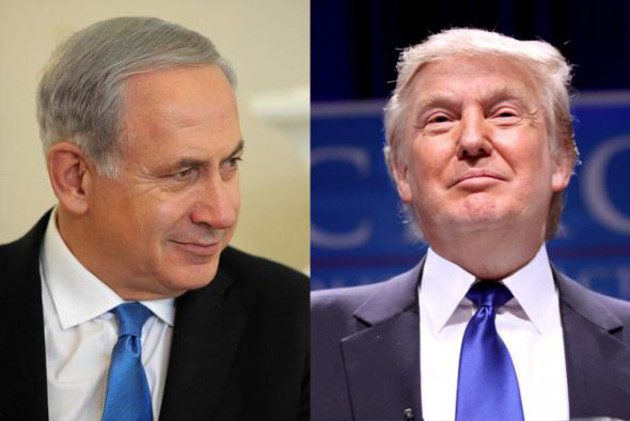
As the joint press conference by President Donald Trump and Prime Minister Benjamin Netanyahu rolled on, it became clear that their prepared remarks were going to contain very little of substance. Trump looked stiff and uncomfortable as he read prepared remarks—so much so that he seemed visibly relieved when he added a few ad lib words of his own. Netanyahu spoke with great care, knowing that his real audience was back in Israel and that the coalition partners to his right needed to be placated.
But in the question and answer period, things got more interesting.
First, we had the clearest indication yet that the United States will support Netanyahu in stepping back from the two-state solution. Trump stated that he would support “the one that both parties like.” Netanyahu stated unambiguously that his red line is security control over all the territory to the Jordan River. That precludes any possibility of a sovereign Palestinian state.
While this may have been the most politically significant outcome of the press conference, the most eye-opening moment was when Trump was asked to directly denounce anti-Semitism. He didn’t even come close to doing so, side-stepping the question with a ham-handed response about all the love we were going to see in his administration and a mention of his son-in-law and daughter.
Shortly after, Netanyahu stepped up to defend Trump, assuring everyone that no one was a greater friend to the Jewish people or the Jewish state than the new President. As Israeli journalist Anshel Pfeffer tweeted, “Rabbi Netanyahu ends the press conference giving Trump a ‘Kosher’ stamp on his love for Jews. Many US Jews won’t like that.”
Not only many, a very clear majority won’t like it. Opinion on whether Trump himself is anti-Semitic is split among Jews, but concern over his actions is widespread. Trump’s connection to white nationalists through his aide, former Breitbart chief Steve Bannon, and his support from that sector have concerned Jews across the United States from the beginning. His refusal to acknowledge the unique Jewish connection to the Holocaust added a good deal of fuel to that fire.
Trump’s performance today will make it worse. The question he was asked was very specifically about rising anti-Semitism since his election. He did not acknowledge that rise, which is by now very well-documented. Nor did he denounce anti-Semitism, not even with a pro forma nod, saying it is not a good thing, something all but his most bigoted supporters would probably have shrugged off. He didn’t say he disagreed with it in any way, in fact.
But there was Netanyahu, the Prime Minister of the Jewish State, the man who has called the accurate labeling of products from Israeli settlements anti-Semitic. That man defended Trump from the accusation. That man, the same one who refused to comment at all on Trump’s refusal to mention Jews at all on Holocaust Remembrance Day, doubled down on his defense of Trump’s questionable actions today.
Coming into today’s meeting, the Trump Administration’s approach to Israel, the Palestinians and the broader Middle East was unclear. It’s only slightly less so now. But we do know a couple of things.
We know that Trump is not going to hold fast to a two-state solution. The fact that he has refused to talk with the Palestinian leadership (CIA Director Mike Pompeo’s meeting yesterday with Mahmoud Abbas notwithstanding) reinforces the hints that were dropped at today’s presser that Trump is seriously considering pursuing a deal between Israel and the Gulf monarchies and from there hoping to conclude a deal with the Palestinians. This ambition reflects a real lack of understanding of the political dynamics in the Arab world, and is almost certainly doomed to failure, but it seems that is a lesson Trump must learn for himself.
We also know that concerns over anti-Semitism matter not at all to the President or, quite sadly, to the Prime Minister. Those concerns were treated by both men today as nothing more than a political toy, a matter of no concern beyond how it needed to be handled and how it could be manipulated for political gain.
In these conditions, it is difficult indeed to fathom how things can improve for Israel, let alone for the Palestinians. Indeed, based on what we saw today, any movement from the already terrible status quo is almost certain to make matters worse.
Republished, with permission, from The Third Way blog.


YR I think a substantial non-Israeli force would also have to be involved, in policing of Palestine’s border with Jordan. The virtually insane Israeli rampages in Gaza would of course not be acceptable.
JC: “YR I think a substantial non-Israeli force would also have to be involved, in policing of Palestine’s border with Jordan.”
That “deal” will not happen, precisely because Netanyahu is insistent that Israel must retain complete control over the borders Palestine in any peace deal.
James, please, why on earth do you think he makes that demand?
He knows that it is a demand that the Palestinians can not possibly accept, and he knows it full well i.e. He Does Not Want A Deal, And This Is His Way Of Avoiding It While Blaming The Palestinians.
He will not accept the idea of “a substantial non-Israeli force” for the very reason that the Palestinians might agree to that. And that is the very last thing he wants.
JC: “The virtually insane Israeli rampages in Gaza would of course not be acceptable.”
*sigh*
I’ve lost track of how many times I’ve said this, but I’ll say it again: Netanyahu is insisting that Israel retains total control over the borders in any peace deal. It is therefore entirely up to **ISRAEL** to decide when and if a Gaza-style “rampage” is “acceptable”.
Or, put another way: Netanyahu wants to be Prosecutor, Judge and Executioner over the lives of the Palestinians within the borders that he controls, and there would be nothing to stop him from thundering “Terror! Terror! Terror!” and imposing a siege for any reason he cares to name.
After all, he sees “Terror! Terror! Terror!” in the very hearts and minds of Palestinians, even if they aren’t actually doing anything.
YR If weapons are kept out of Palestine, there would be no basis for the sort of murderous rampage Israel has put on in Gaza from time to time. But I agree Netanyahu does not want any Palestinian state to emerge.
JW: “YR, You asked me a question, perhaps rhetorically, what I would do if I were the Gazans.”
That is so demonstrably untrue that I’m calling it out for what it is: a bald-faced lie.
Jeffrey, I do not care what you think the Gazans should/shouldn’t do, and I have never asked your opinion on that matter. I never have and I never will.
I have pointed out more times than I care to remember that wether – or not, whatever – the Gazans deserve a good smiting is not going to be a factor in any Palestinian calculus regarding ceding control of their borders to the IDF.
All that matters to them is this:
WHAT COULD THE ISRAELIS DO TO THEM IF IT CONTROLLED THE BORDER?
And the answer is this: Israel could impose a military siege on them.
The only other question they have to ask themselves is this:
UNDER WHAT CIRCUMSTANCES WOULD THE ISRAELIS IMPOSE SUCH A SIEGE?
And the answer is this: that would be totally up to the Israeli PM of the day, with absolutely no avenue of appeal against that decision.
Get it, Jeffrey?
Agreeing to cede control of their borders to a neighbouring state that has already shown a propensity for imposing military sieges is not something that any state would ever agree to.
Your opinion – or mine, or James Canning’s, or anyone’s – on the behaviour of the Gazans simply does not matter.
What matters is what the Palestinians think of Israel’s demonstrable lack of self-restrain when it comes to imposing military sieges on people who have pissed them off.
The Palestinians can never be sure when and under what circumstances an Israeli PM gets soooooo pissed off that he shouts “Terror! Terror! Terror!” and then lowers the clamps.
And because the Palestinians have no way of predicting the level-headedness of Israeli Prime Ministers then the only logical course of action is not to agree to any Israeli PM having that authority over them.
JC: “YR If weapons are kept out of Palestine, there would be no basis for the sort of murderous rampage Israel has put on in Gaza from time to time.”
Easy enough for you to say, James.
But do you really believe that a Netanyahu would concede any limits on what he would consider the “basis” for clamping down on territory that is surrounded by the IDF?
And even if a PM Netanyahu could restrain himself, would a PM Bennett? Or a PM Liberman?
The statement “there would be no basis” is akin to saying “Nah, you can trust the Israelis not to abuse their authority”.
Trust is in very short supply on both sides, James.
From the Palestinian PoV they could not trust an Israeli PM to be persuaded by your equation that No Weapons = No Basis For Imposing A Siege.