
by James A. Russell
It’s hard not to cringe watching the United States careen around the Middle East these days, dispensing bombs, money and political fealty in various doses depending on the crisis of the day to a series of supposed allies that take turns slapping us around while demanding our protection.
These unseemly and contradictory scenes are emblematic of the crumbled bookends of America’s foreign policy in the Middle East that lies scattered around the regional landscape. It’s the rubble of a broken foreign policy paradigm conceived in an earlier era that has ceased its usefulness in the 21st century.
America’s Cold-War era regional foreign policy, which has seen us construct a series of partnerships in Cairo, Tel Aviv, Riyadh, Doha, Abu Dhabi and Islamabad, is no longer relevant to US and regional interests. Moreover, it’s difficult to conceive of a more unattractive group of states to align ourselves with—all of whom engage in behaviors that do not serve American interests and that are inconsistent with our values. It’s time to recast the Sunni-state plus Israel alliance that characterizes American foreign policy in the Middle East.
The busted bookends of our policy are slapping us in the face on a nearly daily basis. On the one hand, we had Bibi Netanyahu on one of his usual forays to the White House, openly dissing President Obama and even suggesting at one point that criticisms of Israel’s ongoing and continuous annexation of Palestinian territory were “un-American.” Thanks for the lecture, Bibi.
Never mind that the United States has implemented what amounts to an expensive social and military corporate welfare program to prop up a state, Israel, which by World Bank standards is among the wealthiest countries in the world. Who’s fooling who, exactly?
Next, we were treated to Vice President Joe Biden bowing down to Gulf State familial sheiks and apologizing to them for openly stating the obvious—that these repressive and autocratic monarchies have to varying degrees supported Sunni extremist groups battling the Iranian-backed Assad regime in the Syrian Civil War.
It’s hard to imagine that these erstwhile allies didn’t think they had American backing in Syria given our own 35-year undeclared war against Iran in which we have sold these states some of the most advanced defense equipment in the world—presumably to protect them from the Iranians.
Vice President Biden has had a long history of sticking his foot in his mouth. As someone that sat through many Senate Foreign Relations Committee hearings over the years, it was clear to everyone that he was/is not one of the deepest thinkers to come from the world’s greatest deliberative body.
Whatever his failings, however, Biden is the second in command of the world’s greatest democracy and the leader of the free world. It was unsettling to see him cap-in-hand before the very sheiks that we have been protecting for the last 35 years.
Never mind that the US has now taken it upon itself to start blasting away at the group that calls itself the Islamic State (ISIS or Daesh) in one of the most mysterious and ill-conceived imperial policing operations in recent US history—in part to protect the autocratic Middle Eastern monarchies that refuse to take any responsibility for their actions.
Last, but not least, we have Secretary of State John Kerry again ricocheting around the region, recently at a donor’s conference pledging $212 million to help “rebuild” Gaza, while simultaneously stating that the current status quo between America’s two client-state antagonists (Israel and the Palestinian Authority) is not sustainable.
There is something surreal about the idea of the United States offering to spend more taxpayer money to rebuild buildings that were destroyed by American-provided bombs and planes in the first place—bombs that will no doubt be freely replenished the next time Hamas and Israel decide to start blasting away at one another.
The reality is that all parties regard the status quo as completely sustainable, in part because they are supported by American money and, in Israel’s case, unlimited political support. America’s political leaders show no interest in placing any meaningful leverage on the parties. Absent any political will to pressure the parties—particularly Israel—it is manifestly unclear why any further money or effort should be expended in trying to solve this long-running dispute. Besides, we could use that $212 million at home to rebuild the dilapidated Lincoln tunnel or one of our many deteriorated highway bridges.
Meanwhile, back at the ranch, the neoconservatives that got us into the Iraq war are desperately trying to undo a possible nuclear deal with Iran—presumably so we and/or the Israelis can start another war to preserve Israel’s nuclear monopoly in the Middle East. Never mind that such a deal creates the opportunity for the United States and Iran to begin cooperation on a host of regional issues in which we share important interests. Détente with Iran would be good for American strategic interests—stakes that far outweigh anything involved in the Arab-Israeli dispute or in our bombing raids in Iraq and Syria.
How did we get to this point? How is it that the United States is shoved around and made fun of like the poor village idiot by a collection of alleged allies that just keep on cashing our checks while making fun of us as soon as our back is turned?
In the end, of course, the joke is really on us. The fact is that the United States will continue to be embarrassed by supposed friends until it decides that it doesn’t want to be pushed around in front of the international community. That requires acknowledging that the two Cold War-era “twin pillar” alliances with the Sunni autocracies and Israel need to be recast. The contradictions in each of these partnerships have now become so incongruous that not even we can square the circle.
The idea of the United States now offering up money to clean up the mess created by the American-made bombs dropped by its Israeli client state aptly describes the depths to which the US has plunged. Gulf Sheiks embarrassing the US vice president provides just another layer of icing on a cake that has been in the oven for far too long. Israel lobbyists fanning out on Capitol Hill to torpedo a nuclear deal with Iran while Israel cashes our checks bespeaks an out of control ally that has lost all sense of decorum and proportion.
The contradictions of American regional policy that have seen us dispense billions of dollars in arms and money to ungrateful and ungracious allies in Cairo, Tel Aviv, Riyadh, Doha, Abu Dhabi and Islamabad while simultaneously protecting them can no longer be reconciled. It’s time for a paradigm change.
Instead, the United States should leave these countries to their own devices and their own quarrels. Most importantly, they should solve their own problems. Perhaps we might have better fortunes in the long run in building a more integrated and peaceful regional order with other states. Anything would be an improvement over what we have now.
Oh, and another thing—let’s stop turning the other cheek the next time one of our supposed allies starts swinging.
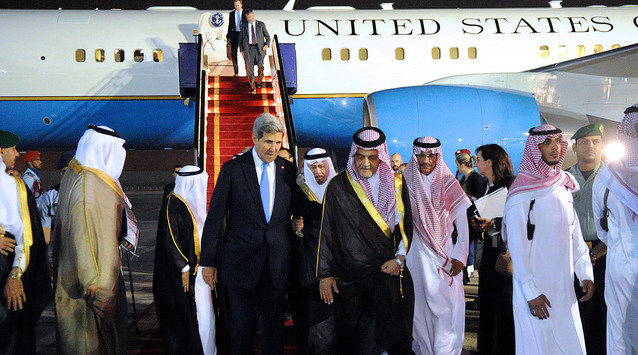
Photo: Saudi Foreign Minister Prince Saud al-Faisal escorts US Secretary of State John Kerry after he arrived in Riyadh, Saudi Arabia, on November 3, 2013.





Norman,
The sad truth is that we make our decisions for emotional reasons, or to justify our actions, then find evidence and arguments to support our views. That is what makes negotiation so difficult.
Of course I don’t like what the WB and Gaza Palestinians have to endure every day. But they are the ones — along with their other Arab brethren — who have made their choices, and now have to suffer them. Was it really so oppressive for the WB Palestinians to be part of Jordan, as they were for nearly 20 years? Nothing separates the West Bankers from the East Bankers except for the accident of their place of birth. Being Jordanian wasn’t good enough, even though their cohesiveness as a “people” was barely a reality yet.
Muslims are triumphalist in their political approach. Why do you think they even built their shrine and mosque on the ruins of the Jewish temple? It’s the ultimate “in your face” gesture (like the “Mosque of the Birthplace” in Northern India that Hindu zealots destroyed, leading to riots — built by the Muslim emperor on a Hindu holy site commemorating a Hindu god). Jews made a big mistake in handing over control of the area to the Waqf, after 20 years of being denied ANY access to the Wall (of course in direct violation of the armistice agreement). It’s only another gesture of moderation and good will that has been greeted with absolute scorn, as a sign of weakness. The top of the Mount is just as sacred to Jews as the Wall — think of Muslims being barred from Mecca. The only reason Jews don’t ordinary go the Mount is because of some 6th Century Rabbinic ruling about the possibility of walking directly over the ancient “Holy of hollies.” For Muslims it is an indignity even to see Jews there.
Israels tried to negotiate a return of all or a portion of the WB immediately after the Six-day War. They got their answer from the Arab League after it met in Khartoum in October ’67: No peace; no negotiation; no recognition. As it was in 1917, it is today: Arabs want the Jews out; just like the Islamic State wants the Kurds out, and the Yazidis out, and the Christians out, and even the Shi’a out. I saw a videotape of an elderly Palestinian lady in Hebron, who was old enough to remember the Arab massacre of Jews there in 1929. She was proud of her memory, and said for the camera that Arabs ought to do something similar again. Hebron, incidentally, is Judaism’s second most holy city, as Medina is Islam’s second most holy city. The Muslim holy site at the same location is there only because of Islamic supersessionist religious doctrine.
Yes, I’m an armchair partisan of Israel. Luckily for that tiny, hated state, they have a lot of friends here in the USA. I suppose it might be because of the magical, Svengali-like influence of the “Israel Lobby” that we hapless Americans are powerless to resist. Or it might be because Israelis generally share our values of openness, freedom of expression, pluralism, and most of all freedom of worship. Why are there no Jewish communities anymore in Egypt, or Iraq, or Syria? Because those Muslim nations have expelled every last Jew from their boundaries. Americans know full well that one condition of any future state that Palestinians have imposed is that not a single Jew will be allowed to live there — even though one fifth of Israel is comprised of Muslims, who worship freely there, and serve in the Knesset and the Israel Supreme Court. Maybe Palestinians should do more to cultivate different friendships. But it kind of interferes with possible alliance with the US when they spontaneously celebrate in the “thousands” (according to the NYT) in the WB after the 9/11 attacks. Polling by a Norwegian research firm in 2005 concluded that 65 percent of Palestinians supported the 9/11 attacks.
You make a fine point there Mike, that’s what makes life interesting, as well as the different viewpoints of this blog. At the very least, we’re still able to give ours, unless I’m being naive about the subject.
Harrison – – People who oppose an independent Palestine often advocate Jordan’s taking control of what shreds of the West Bank would remain. Jordan would be destroyed if this happened.
Norman, I think Israel does have concerns for public opinion in the US, UK, and many other countries. The efforts of the Israel lobby to facilitate Israeli colonization of the West Bank by confusing or deceiving the public, reflects this concern.